Archive for the ‘General’ Category

Customer Services Update for August 2010

Wednesday, August 18th, 2010

Welcome to a issue 3 of the LGP customer services report for the LGP Blog.

Update: Patches are now available for X² and X³, the workarounds for these games are no longer needed. Ballistics might still need it.

Ballistics, X2 & X3: Problems starting on Ubuntu 10.04

Several users have contacted us concerning problems starting Ballistics, X²: The Threat and X³: Reunion.The problem is due to Ubuntu changing their system for managing ld.so paths and the games not handling it like they are suppose to. A patch will be released soon which addresses this problem, meanwhile you can use the following workarounds to play the games. Instead of just using the “ballistics”, “x2″ or “x3″ commands, use one of these to launch the game instead:

Ballistics:

ballistics --withgl $(\tail -n 1 /etc/ld.so.conf.d/GL.conf)

X²: The Threat:

x2 --withgl $(\tail -n 1 /etc/ld.so.conf.d/GL.conf)

X³: Reunion:

x3 --withgl $(\tail -n 1 /etc/ld.so.conf.d/GL.conf)

  • Share/Bookmark

Becoming an LGP reseller

Thursday, January 14th, 2010

We get a lot of emails about becoming a reseller for LGP. So, after dozens of individual answers to people, I’ve decided to write it all up into a blog article, so that the customer service guys can just point people here instead. Also, I thought it may prove interesting to those who are thinking ‘what can I do to help the awareness and spread of Linux games’.

We have tried to make it as easy as possible to become a reseller, and we encourage any company or individual who is interested to apply. You do not need to be rich to start a store, we have resellers that started with no advance money needed.

The different types of reseller

When you decide to become an LGP reseller, you have a number of different options open to you.

  1. Traditional reseller
    This kind of reseller operates in the time honoured tradition of buying stock from us at a discount, and reselling it to their customers. The same kind of reselling that has been going on for centuries in all industries. We offer these resellers a discount of around 40%, and we ask that they buy at least 10 games at a time. Not a huge amount, we like to set the barriers  to entry low.
    Of course, for the bigger buyer, there is incentive to buy more and get bigger discounts. The more games that you buy at once, the bigger your discount.
  2. Dropship reseller
    This kind of reseller is the type with the lowest barriers to entry. If you have a website and would like to sell LGP games, you can simply list all our games, right now if you like, and if you get any orders, simply have us ship them to your customers. You simply login to your reseller account, and buy the game with your credit card, and leave the rest to us.
    This system was set up specifically for those who want to ‘give it a try’, and who don’t want to spend money buying games they aren’t sure they will sell. Of course, with less risk is less profit. The discount for this kind of reselling method is around 30% instead of the 40% we offer for standard resellers.
  3. Download resellers
    This is, as many of you will know, our newest method of game distribution. We offer the ability, with some of our games, to buy a downloadable version of the game. The system for this works a little differently.
    When you sell a downloadable copy of a game, it is the responsibility of the reseller to supply the download to the customer. Whether that be as a disc image (which is how we supply the data to the resellers), an RPM, or any other method, that is up to the reseller. The reseller also needs to supply a key to unlock the game.
    The keys are the bit that you as the reseller would pay for. The discounts on keys are similar to the discounts for standard resellers, but they work a little differently. Instead of asking resellers to buy keys in advance (which they may of course do if they wish), we offer them the ability to buy ‘key credit’ and then buy they keys in real time when a customer orders a game.
    The simple web-based system involves sending a request to our webserver, and if you have purchased enough key credit, then a new key is returned, and you can then provide that key to the customer.
  4. Private groups
    While not quite a reseller, private groups are also welcome to apply for discounts. Examples of such groups would be Linux User Groups, or companies that run Linux desktops who want to buy lots of copies of games for internal use.
    Private groups receive the same benefits as traditional resellers. The same discounts, but just aren’t listed on the website as places to buy our games (for obvious reasons). If you are part of a group that would like to buy games for your group at a discount, you should set up the standard reseller account with us.

So, now you know what the options are, lets get into the mechanics of how.

The task of creating an account is actually very simple. You simply go to our website and follow the ‘Account’ link that you will see on every page of the site. From here, you can follow the correct path, and apply for an account.

Once accounts are created, we check them out, and authorise genuine resellers or groups. We are happy for anyone to apply, but if you are an online reseller, we ask that you have some kind of web infrastructure available for us to examine before you create your account. We generally do not open accounts for people who ‘will make a website soon’. Accounts that are authorised are generally authorised within 24 hours, or we will send you an email to let you know why they have been rejected (which happens rarely).

Each account is capable of any of the resale options described above, you do not have to open a type of account for downloads or for dropship. Just a reseller account.

So, now you know what is available, and how to do it. The last thing to know is why would you.

For three reasons:

  1. For You
    If you own an online or physical store already, our products make a good addition to the lineup, and with the dropship system, you can add them at no risk.
    Even if you don’t, then starting reselling LGP games as a part time website owner, or even to your local Linux using friends, is a nice second income, and probably better than all these ‘get rich quick through Google’ ads that you see all over the place.
  2. For Us
    Simply, because LGP needs as many resellers as we can get. We need as many people talking about our products as possible. The more games we sell, the more games we can make, and the more games we can make, the better it is for you, us, and everyone.
  3. For the Community
    Because games are, without doubt, the big block to Linux adoption on the desktop. Do you want everyone running Linux? So do we, and games help to make that happen.
  • Share/Bookmark

Give a name to the new addition to LGP

Monday, October 5th, 2009

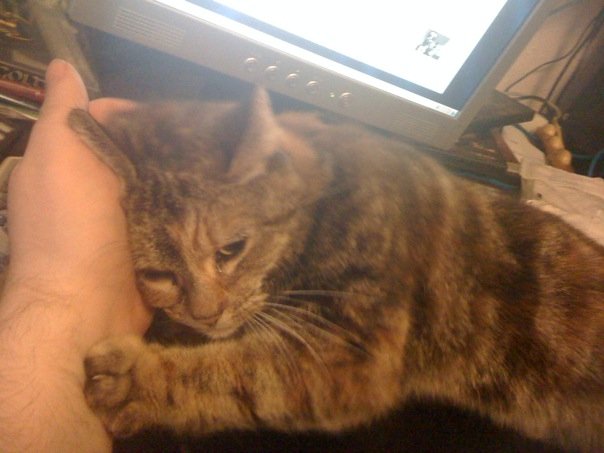
Just under two weeks ago, the LGP office had a visitor.

kitten

It seems that she has adopted us, as she spends pretty much all of her time in the office, and is a constant disruption to work. At every opportunity she loves to sit on keyboards – especially when typing is going on, and she is very insistent when she wants some attention, as you can see from the picture above when she decided to sit on my keyboard and demand my time.

I decided we weren’t going to name her until she had stuck around for a couple of weeks, afterall, she could have just wandered off again. But it does seem she is here to stay.

So, we have a few ideas for names, but we can’t quite decide which, if any, of them are right. So, I thought, lets get a bit of community involvement, and set up a name poll.

So, add your votes below, and if you have suggestions for a better name that isn’t on the list, add a comment, an if we like it, we’ll add it to the poll! You can choose multiple answers if you like.

EDIT Oct 8th: Well, the poll has been going for just under 4 days now, and you can’t leave a cat without a name for too long! We will now be taking the top three, Qwerty, Switch, and CatMonster, and over the next week we’ll see which one seems to fit her best. The one that works best, we’ll name her, and update this post with the final result! Thanks everyone for your contribution, and I’m sorry I never got around to adding some of the new suggestions to the poll!

EDIT Oct 16th: After a weeks trialling, one name is clearly a winner based on her personality and attitude and what comes naturally when talking to her. CatMonster! It is great as an all-purpose name that can have its start changed, so when she meows a lot she is a NoiseMonster, when she’s asleep she can sometimes be the SnoozeMonster. And when she sneezed a while ago she was the SnotMonster. All in all, CatMonster wins!

So, what should we call the LGP cat?

View Results

Loading ... Loading ...

A bit of explanation as to some of these names…

  • CatMonster: A bit like KateMonster from Avenue Q
  • Ceefer: Ceefer Cat. Say it aloud, you’ll get it.
  • Natasha: The whole Boris and Natasha thing, and she likes eating spiders (Boris the spider). Its a bit convoluted, but made the list
  • Piper: She’s a mouser. So from the Pied Piper. Also has a nice link in to the ‘Charmed’ TV show
  • Quark: She loves having her ears scratched, so a Ferengi name was needed!
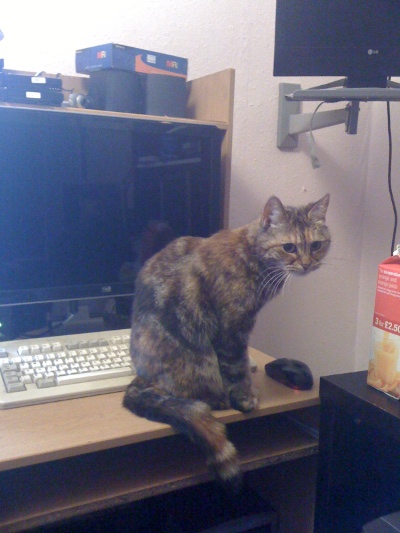
  • Qwerty: She is a keyboard cat. Obvious really
  • Splodge: I mentioned the new addition to my mother on the phone a week or so ago, and she insisted this be the new name.
  • Spot: Another Star Trek reference. Data’s cat.
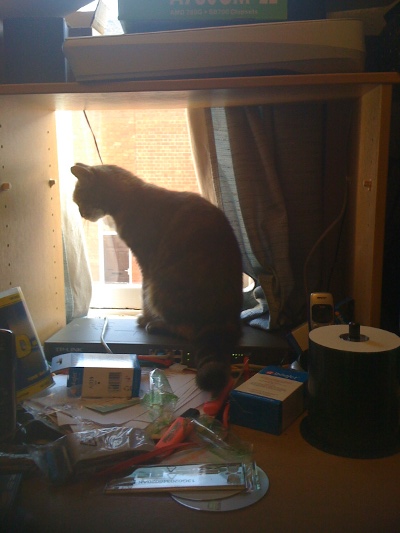
  • Switch: Her favourite place to sit is on the office gigabit switch. Its warm and by the window. Also a Matrix tie-in
  • UsrBin: /usr/bin/cat. OK so cat is usually in /bin but you can’t call a cat just Bin
cat11 cat2
  • Share/Bookmark

LGP History pt 3: The long haul

Tuesday, August 25th, 2009

With Majesy out of the door, and releases complete for Mindrover and Candy Cruncher, we began what turned out to be the long slog.

At that point, fresh from our completion of Majesty, we were convinced world domination was just around the corner and we would all have our ferraris quite soon. We had a number of copies of Majesty printed (no, I’m not saying how many), and expected to have to get a reprint within 2 months, judging by the number of applications for the beta test, and the enthusiasm shown by people.

Over the next few months, reality, and a certain level of depression set in. We didn’t need to reprint Majesty. In fact in the first 3 months we didn’t even sell a quarter of the copies we had produced, and after the first few months, sales begin to slow down, so it didn’t look likely that we would suddenly see a huge rush of orders. The optimism pretty much evaporated.

So, realising it wouldn’t all be parties and glamour and free money by the bucketload, we settled down to some real work. We had more projects going on, with NingPo, Soul Ride and HDB, and we had new ideas. One of the new ideas that we went with was to open a physical shop.

Not a lot of people know we did that. We opened a shop in Nottingham, that was selling games. I admit we didn’t just sell Linux games, we sold all kinds of games, but the idea was to get a bit of local publicity for Linux games, while raising money using sales of other games, to fund the development of Linux games. It also didn’t feel horrible to see a shop where Linux games were on the same shelves as Windows games.

To be honest it didn’t do that great. The shop was small, and the people we rented the premises from made vastly inflated claims of how busy the mall we rented in was. Oh they didn’t lie, but they neglected to mention that the figures for mall visitors also included people walking in one side and straight out of the other side, as it was the only direct route from the city centre to the train station… However we sold a few Linux games, and increased company turnover (which always looks good on the books). In the end though, it was fairly obvious it wasn’t going to be the cash cow we had hoped for, in fact it was more a cash sink. So we closed it down after a few months.

Shortly after, I had been invited to talk at LinuxWorld Expo in San Francisco, and on my return to the UK, found we had had a disaster. Overnight on the day I returned, our stock room (also our server room) flooded. Our premesis is on a hill, and a severe rainstorm caused a building uphill from ours to flood, and the flooding cascaded downhill until reaching our stockroom, which seemed to be waterproof on the downhill side and not on the uphill side. End result was that the water pooled there, causing thousands of pounds of damage, and days of downtime. 6 inches of water took several days and a quite elaborate pumping system to remove, and obviously while half of the electrical system was underwater, we couldn’t fire up the servers!

Luckily, the damage wasn’t catastrophic. while hundreds of games had been destroyed, and computers had been submerged, no game was completely wiped out of stock, so we had no mad rush to reprint, and no orders were delayed. Backups ensured no data had been lost, but it was a bit of a scare! We spent a good few days raising everything in the room up by 6 inches, so that if it ever happened again we wouldn’t have a big problem, and we even installed a pumping system just in case!

Following one disaster, it is only appropriate that we mention another company disaster at this point. Disciples, a great game, but unfortunately LGP’s DNF. It was around this point that Disciples caused the first of many resignations from LGP. Mike Phillips left the company after one too many late nights trying to beat the game into submission. It isn’t that there is anything wrong with Disciples, it is simply that you need a developer with just the right development style to be able to port it, and they have proven hard to find over the years. And so over those years, Disciples has been part-ported several times, leading to belief it will never be released. I can say for sure it will be released, I just cannot, still to this day, say for sure when!

Despite the downsides, the flooding, the game that refused to be ported, and the staff that left, we had successes. Postal 2 became the fastest selling game in its first month, and when we looked back at the accounts we found that we had, in many ways done it right. The company had proven itself sustainable. Where Loki had come in in a blaze of glory and burned out just as quickly, we had been around for as long as Loki, and we were still here. We were not as high profile, the games we ported were not the ones you see advertised on TV, but they were all undoubtedly as good as the games produced by Loki. Just because a game is high profile doesn’t make it good, and just because a game is less well known doesn’t make it bad.

So, we were stable, we were ready for the future, and we now had to make some decisions. How could we grow. What could we do to drag Linux gaming into the mainstream. And how could we do it without the blaze of glory ending…

  • Share/Bookmark

Why you won’t get a Linux installer for the Windows version

Sunday, August 9th, 2009

We probably get this question at least once or twice a week, ‘I already bought this game for Windows, can I just get an installer for Linux for free’.

In some ways it is a fair question, you bought a license to play the game, but in reality it is not going to happen. Let me explain why.

When LGP ports a game, it takes time and money. We only get revenue back from people buying the Linux version. This means that if we were to say ’sure’ to that question, we would then suddenly get no revenue, as buying the windows version will earn us nothing.

We license games from companies who make the Windows version, and we do not get paid for making the games, and so selling them is the only revenue we receive. If, for example, you bought a game for Windows, you wouldn’t expect to be able to get a free copy of the same game for the Playstation. This is pretty standard for any industry. If you go pay to see a film at the cinema, you wouldn’t expect to get free pay-per-view access of the film on TV later on just because you paid money to the cinema.

We have had many people try and justify why they should have a free installer. We even had one bright spark take the demo for X2, hack the Windows datafiles into it, and then came asking for help wondering why he couldn’t save the game. The answer of course being ‘its a demo, its meant to not save the game’. Our demos are all written in such a way that they will not run the full version of the game.

Some Linux games, for example Quake 4, you get a downloadable installer because the same people who made the Windows version made the Linux version. They went to the expense and they recoup the money by selling the Windows boxed version. Other times, such as Unreal Tournament, where Loki released a downloadable installer for the Windows boxed version, the company who made the Linux version were paid to do so, and so the revenue is generated in that way. This is not the case with LGP games, and is unlikely to become so.

Of course, to leave things on an optimistic note, when Linux finally becomes the ruler of the desktop, then of course, Linux versions will be released first, and Windows gamers will end up in the shoes we Linux gamers currently wear. However, that will be a while coming, so until then, the answer is no. No installer!

  • Share/Bookmark

LGP History pt 2: The Early Days

Tuesday, June 23rd, 2009

Thanks to everyone that posted and emailed about part one of this history. I’m glad you enjoyed it, and here is part 2…

So, there I was, back in the tail end of 2001, with a contract to do Creatures and Majesty, and really, no idea how. Creatures wasn’t much of a problem, as Creature Labs had done the port already, and just needed a publisher. I pretty much winged that, I got the game made up, but made the mistake of doing it in parts. To this day, each copy of creatures that is shipped has to be hand assembled with each of its 4 parts. It may not sound like much, but over the years, it’s been a real pain. All other games we had made since then, we had made ready to ship.

At around this time I got the news that we had all been expecting. Loki was going out of business. I immediately contacted Loki, and asked them if LGP could obtain the rights to carry on producing the games they had made. This would have been a great boost to the new company, and would have allowed us to keep on making the games that were still in great demand by Linux gamers. Unfortunately Scott, the CEO of Loki at the time, was asking for such a ludicrous amount of money for the licenses (way more than they were possibly worth, and probably more money than the games had made by selling for the entire history of Loki) that I had to let the idea go. We made a second attempt at the liquidation of Loki to acquire the rights, but the company handling the liquidation was so unprofessional, that they made it impossible to do so. With their policy being that the only way for me to officially state our interest being to fax them, and their only fax machine being broken for over 2 months (they kept telling us it would be fixed any day), we didn’t really have a hope. The liquidation hearing came and went before they contacted me, several months later, and acknowledged LGP’s interest in the liquidation. Not a lot of use really.

So then there was Majesty. I had the porting rights, but I had no idea what to do with it. I mean, I pride myself in being a very good programmer, but porting was something I had no real experience in.

Sam saved the day. Sam Lantinga, previously one of the Loki developers, pointed me at a number of ex-Loki staff who were still interested in doing more porting work. Of those, Mike Phillips was the one that ended up joining us, and even though he left the company some years ago, his influence shapes the way we do porting development to this day.

Mike spent quite a while pushing me in the right direction. I had a number of preconceptions that he had to beat out of me, but I also had to push back on some of his ideas, and I think, in the end, we got the right mix of decisions. Mike set up the idea for the LGP build environment, one that we still use a derivative of, as it has proven to be a build system that is very very portable, and enables us to make games that run on all distros. He also introduced me to the idea of IRC, which has enabled the company to have a real interaction with our customers.

Before Majesty work could start, Mike spent a number of months sorting out the LGP build system, and building some of the basic building blocks that LGP uses to make porting easier. He wrote wrapper functions for file handling and other common tasks, and established the tools we would use for our games. SDL for input and graphics, smpeg for video, SDL Mixer for sound, and openplay for networking, were the main choices.

Majesty work started in earnest. Mike spent a lot of hours on the project, while I carried on trying to find resellers and distributors for our games, and at the same time finding new games for the company. I ended up making an agreement for a couple of smaller games by Pyrogon, and also managed to pick up the rights to Mindrover, one of the Loki games we had missed out on earlier.

Majesty porting finally came to an end, and then we had a decision to make, that has influenced how we do business from that moment, and a decision I am very happy that we made right. After the beta test, we had one bug left, where network games occasionally went out of sync. Mike wanted to go gold, and ignore the bug. I wanted to find the bug, despite the fact that the bug happened in the Windows version too. I put my foot down and insisted, and that was a turning point for the company. From then on, LGP’s policy was always to delay release as long as it takes, to get a good release, not an almost right game, but one that we can be proud of. So Mike spent a good few weeks hunting for the bug. In the end, I joined him in the hunt when his resolve started to waiver, and between us, we found the bug after a hunt that lasted for over 8 weeks. It was a simple 1 line change, and the multiplayer game was fixed.

Majesty was finished, and our first game, ported from scratch, was done!

  • Share/Bookmark

The sale, and the results

Monday, June 8th, 2009

Now that some time has gone by, and the numbers have been looked at, we have reached a conclusion about the sale.

The thing is, a one day sale can never give us useful information. The one day sale was a HUGE success. We turned over more stock in one day than we usually do in 6 months. The problem is, we made less than we would usually make in a month.

But that sale was never part of the calculations. The real test came after.

We looked at the sales figures from resellers. These sales figures spanned a number of weeks, and gave us a much better idea of how sales long term would go, when prices were lower.

The first week of sales was, as expected, higher than usual. Week two, sales dropped back to the same sales levels as we were getting before the sale was announced. Week three, sales levels stayed flat, at around the level of before the sale was announced.

This was the important test. What happens over an extended period of time, and the result was, the same number of sales, less profit per sale.

And so, I think we can say that we gave it a shot, we gave a fair ear to the people that demanded lower prices, and the result was, it is not economical for us to do so. Sales spike, obviously, but then go back to normal. A person coming to the site seems no more or less likely to make a purchase based on the lower prices.

On the plus side for those that wanted lower prices, we now have the rental scheme in place and at least one reseller implementing it, and so, some games are now available at the lowest prices ever!

  • Share/Bookmark

LGP History pt 1: How LGP came to be

Friday, May 15th, 2009

We get asked this quite often, just what made me start LGP.

Back in the day, 1999, around august time to be exact, I was working for a fairly horrible company in London. I had been a beta tester on Loki’s Civilisation: Call to Power, but I couldn’t easily buy a copy from anywhere in the UK. Finally, a friend and I ordered it from the states. We waited weeks for the delivery, and finally a month or so after ordering, it arrived.

While I was waiting, I muttered and grumbled while at work about how I didn’t like waiting for weeks for a game, and someone in the office said to me ‘hey, why don’t you start up a company in England then, selling games for Linux.

I thought about it for a bit, and that evening, I registered tuxgames.com

I spent the next few months writing the website. It was a very basic website (some people accuse the current site of being basic, the old one was much much worse). I spent about £300 buying 5 copies each of the 4 Loki games that were available at that time.

Then I was ready, and at 10 seconds past midnight, Jan 1st 2000, the site launched, making us probably the first new company of the new millennium. I wasn’t there to watch it launch, I set up a crontab to remove the pre-launch index.html, and I was up at Colchester Castle watching the millennium fireworks {:-) I got back a couple of hours later and found that it had launched, so I sat back to wait for the orders to come rolling in.

It took days, and I admit I was getting a bit fidgety waiting to see if anyone would order. Mon, 03 Jan 2000 23:42:44 GMT is the timestamp in the database of the first order. For privacy reasons I will not name the individual who was the first to order, but if you ordered then, and you are in Morcambe, Lancs, England, you were our first order. He only ever ordered twice…

I used to run Tux Games more as a sideline while I kept up my day job, it didn’t sell too many copies, but there was a steady flow, and I was enjoying it. We sold mostly Loki titles, but a few others came along occasionally, games like Theocracy, or Reel Deal Slots, or the games from BlackHoleSun. The guys over at linuxgames.com and the Linux Game Tome had both spotted the domain before launch (how they found it, I do not know), and they gave us some great publicity, and really helped us get going.

Throughout 2000, we forged a close relationship with Loki, helping them out with their beta tests (we handled their beta test preorders, as their store was not set up to do it), and we had advance access to most of their releases.

During 2001, Tux Games grew quite quickly, there were three of us doing part time work on the company, and I was set to quit my day job to start on it full time. I had arranged to do that, when Loki started to hit the financial troubles that were to prove its downfall.

Loki almost took Tux Games down with them, when they withdrew our credit line, because they needed the money from us immediately, and we were left needing to find a LOT of money for games that we had sold in preorders, but our credit card processor had not sent us the money for yet. Thanks to a couple of friends who trusted me to max out their credit cards for a couple of weeks, we survived. My friends got their money back, and Tux Games stayed in business. I was fairly annoyed at Loki for breaking their word and putting us in the position though.

Although we never had advance notice that Loki was about to declare bankruptcy, we could kindof feel it in the air. At that point I had quit my job and was working full time on Tux Games, and the horrible thought crossed my mind that, if Loki went under, Tux Games would have nothing left to sell, and I would have to go and get myself a new job! I didn’t like the sound of that at all!

I had heard of a few games that Loki had been talking about maybe porting, and so I got in contact with Creature Labs, and Cyberlore, who were both really quite helpful. We got our first 2 publishing deals, and I launched Linux Game Publishing on Oct 15th 2001, and announced our first title on 12th of November, Creatures: Internet Edition.

LGP was officially in business.

  • Share/Bookmark

Why do Linux games cost what they cost?

Saturday, April 11th, 2009

The cost of games on Linux has been an ongoing contentious issue, and one that I have responded individually on many occasions.

A lot of people have made the complaint ‘but I can get this game for half the price on Windows’.

Sure, you often can. But that isn’t the point. The point is, Linux isn’t Windows. We try and release our games at a price that is comparable to, if not a little lower then, a new release game on other platforms. For example, our newest three games have been priced with X3 at £30, Jets’n'Guns at £15, and Sacred Gold at £27. Compare this to 3 new releases for Windows, Sims 3 at £40, Spore’s expansion at £20, and Street Fighter IV and £30. The prices are comparable.

We agree that most games we produce have already been out on Windows for a while, but thats the big point. Why does a Linux user care about what is available on another platform? It is a new game to THIS platform. A couple of years ago, I saw a copy of Doom 1 for the PS2 for £50 when the engine was already open sourced and you could buy the windows version for about a pound. Thats what happens on other platforms.

So, thats one reason.

The other is, the price reflects what it costs us to make it.

We have to pay developers who often have to spend months rewriting large portions of a game. Porting isn’t a 5 minute job, stick it in a Makefile and gcc will take care of the differences. Not even close. Developers take months making the games run on Linux, and we have to ensure we can pay them properly for their work.

Another question we are often asked is ‘I bought this game for Windows, can I just download a copy for Linux because I’ve already paid for it’.

The answer is no. It will always be no. We get no share of revenue from the sale of the Windows version. I understand why people are reluctant to pay for it twice, but look at it from our point of view. We spend months making a game, and then people expect us to give it away for free because they gave money to another company. Thats like going into McDonalds, buying a coke, drinking it, then going into BK and asking for a refill! The product is the same, the company is different.

When it comes down to it, we know we cannot compete with Windows games on price for the game. We take a finished Windows product and make it run on Linux. This means by the nature of our business we will release after the game is available on Windows, and the shelf-life of a Windows game is so short that it is highly unlikely we will release the game while it is still on the full price new releases shelf. And so it comes down to this:

We release games for the Linux OS. If you are going to dual boot, or have a second Windows machine for gaming, then you will be able to get it cheaper. Just like if you own a PS3, a game for Windows will be £10 cheaper when it comes out. Or if you own a mac, the games will be at the same price level as Linux games, sometimes earlier, sometimes later.

If you want more games for your OS, then you need to buy the ones that are available. If you just want cheaper, then buy for Windows, but don’t complain when there arent enough games for Linux.

  • Share/Bookmark

Special Edition, while they last!

Saturday, March 14th, 2009

I thought today that I’d just post a picture here, of something that in a few weeks will probably never be seen again.

So, without further ado, here is a photo of just over 200 copies of X3 Special Edition all in one place!

x3specialedition

  • Share/Bookmark